
Visualize fitted growth curves, derivatives, and growth statistics#

This tutorial demonstrates how to visualize fitted growth curves, derivatives, and growth statistics.

The workflow includes:

  1. Generating growth data and fitting models

  2. Plotting mechanistic model fits

  3. Plotting phenomenological model fits

  4. Visualizing phase boundary methods

  5. Plotting derivatives (μ and dOD/dt)

  6. Comparing growth statistics across models

For a notebook focused on the analysis workflow only (without plotting), see analysis.ipynb (Fit growth models and extract growth statistics)

import numpy as np
import pandas as pd

import growthcurves as gc
from growthcurves.inference import compare_methods
from growthcurves.plot import plot_growth_stats_comparison

Generate synthetic data#

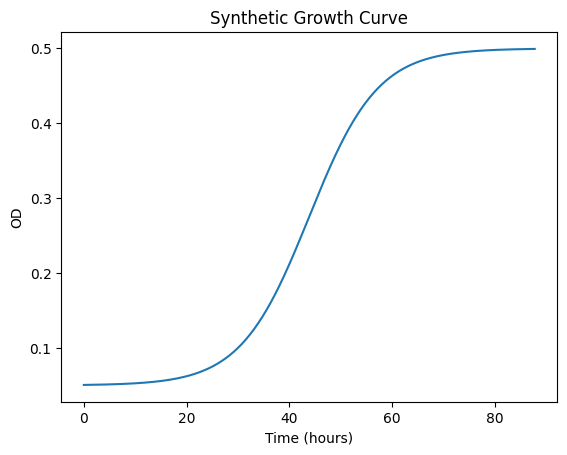
This cell generates synthetic growth data from a clean logistic function.
Hide code cell source

# Generate synthetic growth N from logistic function
np.random.seed(42)

# Parameters for synthetic growth curve
n_points = 440
measurement_interval_minutes = 12
t = np.array([(measurement_interval_minutes * n) / 60 for n in range(n_points)])


def logistic_growth(t, baseline, N0, K, mu, lag):
    """Logistic growth model with smooth transition through lag phase"""
    # Standard logistic formula centered at lag time
    # This creates a smooth S-curve with inflection point at t = lag
    growth = K / (1 + ((K - N0) / N0) * np.exp(-mu * (t - lag)))
    return baseline + growth


# Generate clean logistic curve
N = logistic_growth(t, 0.05, 0.05, 0.45, 0.15, 30.0)
N = N.tolist()

_ = pd.Series(N, index=t).plot(
    title="Synthetic Growth Curve", xlabel="Time (hours)", ylabel="OD"
)
../_images/f05aefadfb262d2788bc3138fa07a0674e74f78c5f3d65a5fbba7750508574dd.png

Fit and compare all methods using the compare_methods function, then filter to only phenomenological and non-parametric models for comparison.

Hide code cell source

# Fit and extract stats for all phenomenological models (parametric and non-parametric)
phenom_fits, phenom_stats = compare_methods(
    t,
    N,
    model_family="all",  # Include mechanistic, phenomenological, and non-parametric
    phase_boundary_method="tangent",  # tangent or threshold
    spline=0.2,
    window_points=7,
)

# Filter to only phenomenological and non-parametric models for comparison
phenom_model_names = [
    "phenom_logistic",
    "phenom_gompertz",
    "phenom_gompertz_modified",
    "phenom_richards",
    "spline",
    "sliding_window",
]
phenom_fits = {k: v for k, v in phenom_fits.items() if k in phenom_model_names}
phenom_stats = {k: v for k, v in phenom_stats.items() if k in phenom_model_names}

# Phase boundary comparison on spline fit
fit_spline = phenom_fits.get("spline")
if fit_spline is None:
    raise RuntimeError(
        f"No spline fit produced; available fits: {list(phenom_fits.keys())}"
    )

phase_boundary_rows = []

# Tangent method
stats_tangent = gc.inference.extract_stats(
    fit_spline, t, N, phase_boundary_method="tangent"
)
phase_boundary_rows.append(
    {
        "label": "tangent",
        "method": "tangent",
        "lag_threshold": np.nan,
        "exp_threshold": np.nan,
        "stats": stats_tangent,
    }
)

# Threshold methods
for frac, label in [(0.10, "threshold_low"), (0.30, "threshold_high")]:
    stats_threshold = gc.inference.extract_stats(
        fit_spline,
        t,
        N,
        phase_boundary_method="threshold",
        lag_threshold=frac,
        exp_threshold=frac,
    )
    phase_boundary_rows.append(
        {
            "label": label,
            "method": "threshold",
            "lag_threshold": frac,
            "exp_threshold": frac,
            "stats": stats_threshold,
        }
    )

print(f"Generated {len(N)} data points over {t[-1]:.1f} hours")
print(f"OD range: {min(N):.3f} to {max(N):.3f}")
print(f"Fitted {len(phenom_fits)} phenomenological models")
Generated 440 data points over 87.8 hours
OD range: 0.051 to 0.499
Fitted 6 phenomenological models
fit_sliding_window received unused kwargs: {'spline': 0.2}

Mechanistic Models - Fit Visualization#

Example: Plot phenomenological Richards model

Hide code cell source

# Example: Plot phenomenological Richards model
# Fit phenomenological parametric models
fit_phenom_richards = gc.parametric.fit_parametric(t, N, method="phenom_richards")
stats_phenom_richards = gc.inference.extract_stats(
    fit_phenom_richards, t, N, phase_boundary_method="tangent"
)

# Create base plot with data
scale = "log"
fig = gc.plot.create_base_plot(t, N, scale=scale)

# Annotate with fit and growth statistics (all annotations shown by default)
fig = gc.plot.annotate_plot(
    fig,
    fit_result=fit_phenom_richards,
    stats=stats_phenom_richards,
    scale=scale,
)

# Add title and display
fig.update_layout(
    title="Phenomenological Richards Model",
    height=500,
    width=800,
    template="plotly_white",
)
fig.show()

Phenomenological Models - Growth Statistics Comparison#

Compare growth statistics across all phenomenological methods (parametric and non-parametric).

Hide code cell source

# Fit and extract stats for all phenomenological models (parametric and non-parametric)
phenom_fits, phenom_stats = compare_methods(
    t,
    N,
    model_family="all",  # Include mechanistic, phenomenological, and non-parametric
    phase_boundary_method="tangent",  # tangent or threshold
    spline=0.2,
    window_points=7,
)

# Filter to only phenomenological and non-parametric models for comparison
phenom_model_names = [
    "phenom_logistic",
    "phenom_gompertz",
    "phenom_gompertz_modified",
    "phenom_richards",
    "spline",
    "sliding_window",
]
phenom_fits = {k: v for k, v in phenom_fits.items() if k in phenom_model_names}
phenom_stats = {k: v for k, v in phenom_stats.items() if k in phenom_model_names}

# Plot growth statistics comparison for phenomenological models
fig_phenom_stats = plot_growth_stats_comparison(
    phenom_stats,
    title="Phenomenological models: growth statistics comparison",
)

fig_phenom_stats.show()

# Display as table
phenom_df = pd.DataFrame(phenom_stats).T[
    [
        "mu_max",
        "doubling_time",
        "time_at_umax",
        "exp_phase_start",
        "exp_phase_end",
        "model_rmse",
        "fit_method",
    ]
]
phenom_df
fit_sliding_window received unused kwargs: {'spline': 0.2}
mu_max doubling_time time_at_umax exp_phase_start exp_phase_end model_rmse fit_method
phenom_logistic 0.079979 8.666571 36.246092 21.923804 50.658696 0.000817 model_fitting_phenom_logistic
phenom_gompertz 0.092212 7.516896 33.782766 25.07681 48.666283 0.005205 model_fitting_phenom_gompertz
phenom_gompertz_modified 0.089873 7.71256 33.430862 23.467609 48.628298 0.00408 model_fitting_phenom_gompertz_modified
phenom_richards 0.078659 8.812088 36.597996 21.241111 50.891908 0.000506 model_fitting_phenom_richards
spline 0.077924 8.895163 36.178894 21.572282 50.946358 0.0 model_fitting_spline
sliding_window 0.077894 8.898575 36.2 21.56668 50.952021 0.000005 model_fitting_sliding_window

Phase Boundary Detection Methods#

Visualize how different phase boundary detection methods affect exponential phase identification.

Two methods are available:

1. Threshold Method#

  • Tracks instantaneous specific growth rate μ(t)

  • Phase starts when μ exceeds a fraction of μ_max (default: 15%)

  • Phase ends when μ drops below the threshold

2. Tangent Method#

  • Constructs a tangent line in log space at maximum growth rate

  • Extends tangent to intersect baseline and plateau

Generate the phase boundary comparison#

  • see plots

Hide code cell source

# Phase boundary comparison on spline fit
fit_spline = gc.non_parametric.fit_non_parametric(
    t, N, method="spline", spline=0.2, window_points=7
)

phase_boundary_rows = []

# Tangent method
stats_tangent = gc.inference.extract_stats(
    fit_spline, t, N, phase_boundary_method="tangent"
)
phase_boundary_rows.append(
    {
        "label": "tangent",
        "method": "tangent",
        "lag_threshold": np.nan,
        "exp_threshold": np.nan,
        "stats": stats_tangent,
    }
)

# Threshold methods
for frac, label in [(0.10, "threshold_low"), (0.30, "threshold_high")]:
    stats_threshold = gc.inference.extract_stats(
        fit_spline,
        t,
        N,
        phase_boundary_method="threshold",
        lag_threshold=frac,
        exp_threshold=frac,
    )
    phase_boundary_rows.append(
        {
            "label": label,
            "method": "threshold",
            "lag_threshold": frac,
            "exp_threshold": frac,
            "stats": stats_threshold,
        }
    )

Hide code cell source

def build_phase_plot(label, stats, fitted_model):
    fig = gc.plot.create_base_plot(t, N, scale="log")
    # All annotations shown by default, including tangent line
    fig = gc.plot.annotate_plot(
        fig,
        fit_result=fitted_model,
        stats=stats,
        scale="log",
    )
    fig.update_layout(title=label, height=500, width=800, template="plotly_white")
    return fig


# Create plots for each phase boundary method
fig_tangent = build_phase_plot(
    "Spline fit + tangent phase boundaries",
    phase_boundary_rows[0]["stats"],
    fit_spline,
)
fig_threshold_low = build_phase_plot(
    "Spline fit + threshold phase boundaries (low=0.10)",
    phase_boundary_rows[1]["stats"],
    fit_spline,
)
fig_threshold_high = build_phase_plot(
    "Spline fit + threshold phase boundaries (high=0.30)",
    phase_boundary_rows[2]["stats"],
    fit_spline,
)

fig_tangent.show()
fig_threshold_low.show()
fig_threshold_high.show()

Derivative Visualizations#

Visualize growth curves and their derivatives:

  • Specific growth rate (μ): d(ln N)/dt - the per capita growth rate

  • First derivative (dOD/dt): The rate of change of OD

Hide code cell source

# Use spline fit for derivative plots
stats_for_derivative = phenom_stats.get("spline")
if stats_for_derivative is None:
    raise RuntimeError(
        f"No spline stats available; available models: {list(phenom_stats.keys())}"
    )

phase_bounds = (
    stats_for_derivative["exp_phase_start"],
    stats_for_derivative["exp_phase_end"],
)

# Plot specific growth rate (mu)
fig_mu = gc.plot.plot_derivative_metric(
    t,
    N,
    metric="mu",
    fit_result=fit_spline,
    phase_boundaries=phase_bounds,
    title="Specific growth rate (mu)",
)

# Plot first derivative (dOD/dt)
fig_doddt = gc.plot.plot_derivative_metric(
    t,
    N,
    metric="dndt",
    fit_result=fit_spline,
    phase_boundaries=phase_bounds,
    title="First derivative (dOD/dt)",
)

fig_mu.show()
fig_doddt.show()